In my last post I outlined the story of how in my teen years my love for the DC comic book character Swamp Thing nurtured a fascination with the English folkloric Green Man. This fascination naturally lead me to a discovery of “Foliate Head” carvings in medieval English architecture.
Once I became aware of the “Foliate Head” or so called Green Man motif in English Romanesque and Gothic architecture, I assumed the motif was tangible evidence of the folkloric Green Man’s influence on medieval Christianity. My assumption seemed a plausible jump but ultimately I was late coming to the game as others had already made the jump.
In her 1939 Folklore article titled “The ‘Green Man’ In Church Architecture,” Lady Raglan already asserted the connection between the folkloric (if not the pagan) Green Man, and the foliate heads of English medieval architecture. Raglan writes:
This figure, I am convinced, is neither a figment of the imagination
nor a symbol, but is taken from real life, and the question is whether
there was any figure in real life from which it could have been taken.
The answer, I think, is that there is only one of sufficient importance,
the figure variously known as the Green Man, Jack-in-the-Green,
Robin Hood, the King of May, and the Garland, who is the central
figure in May-day celebrations throughout Northern and Central
Europe (page 50).
Lady Raglan’s thesis has been resisted by Architectural Historian Richard Hayman (see The Green Man: Cathedral Carved Heads from the Twelfth to the Sixteenth Centuries), fiction author Emily Tesh (see “Inventing Folklore: The Origins of the Green Man“), and “Foliate Head” enthusiasts like James Coulter (see The Green Man Unmasked: A New Interpretation of an Ancient Riddle). Nonetheless, Lady Raglan’s naming of the Foliate Head architectural motif as a “Green Man” persists today and continues to inspire fantasy literature, as well as contemporary pagan pantheons.

Pages 48 & 49 from Lady Raglan’s article “The ‘Green Man’ In Church Architecture,” Folklore, March 1939. Image sourced from the Mary Evans Picture Library.
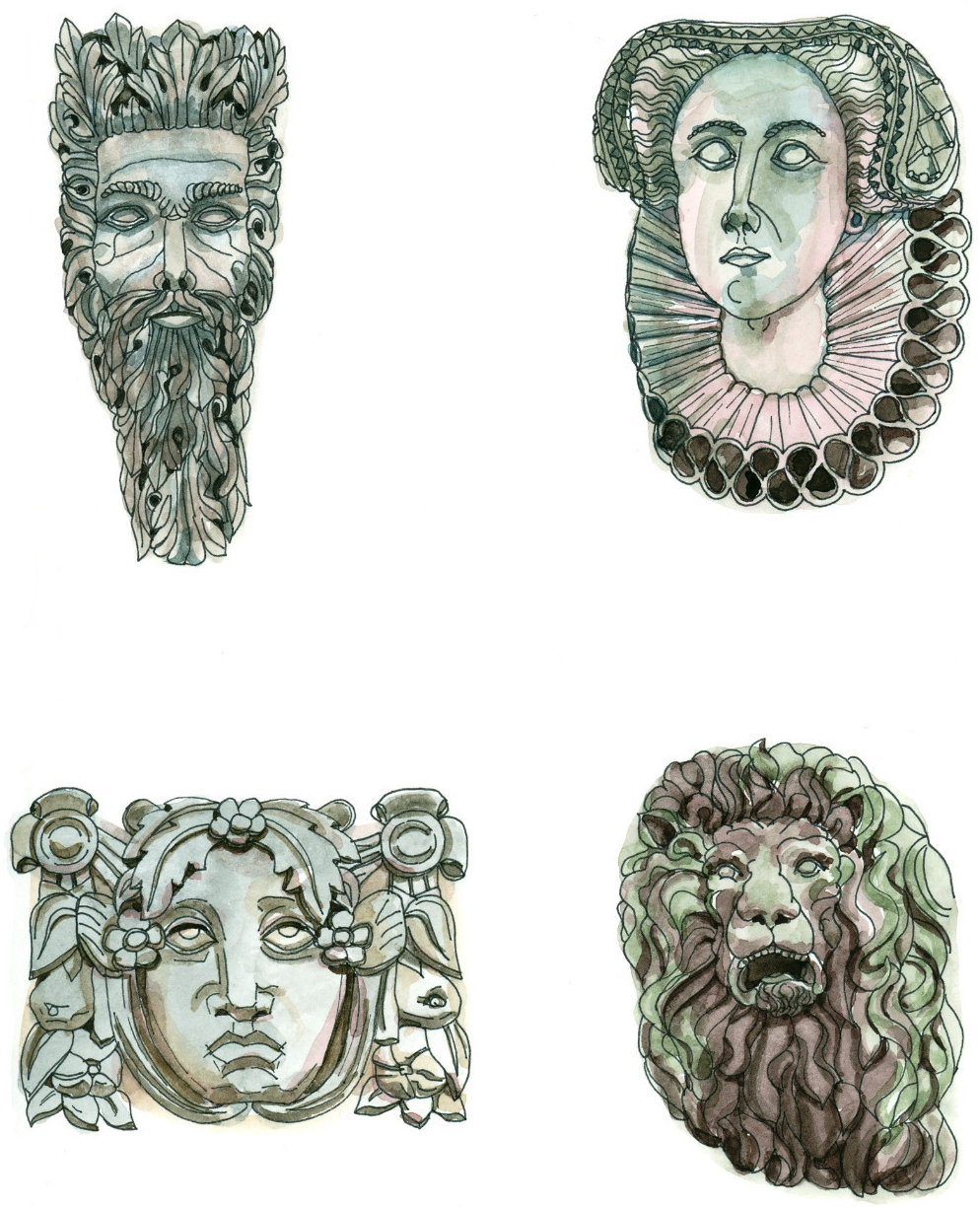
It wasn’t until 2009 that I discovered my first Foliate Head carving after moving my family to the harbour city of Halifax, Nova Scotia. I was excited to see intricately craved Green Man heads on the Halifax Court House, a Victorian Italian Renaissance structure built predominantly in 1863 by the Scottish born stonemason George Lang (1821-1881). You can see my ink and watercolour depiction of one of Lang’s Green Man heads at the very top-left of this blog post.
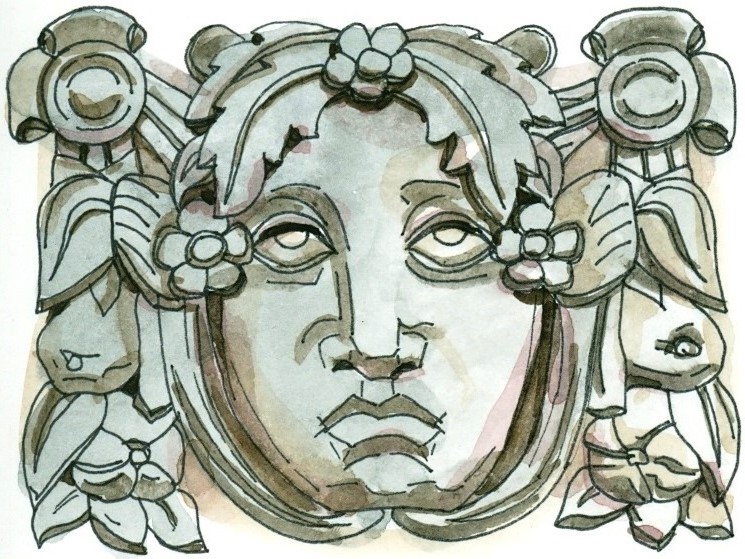
I later stumbled across a Foliate Head carving at the Scotia Bank Head Office very near the city’s waterfront. The head was designed by Canadian architect John Lyle (1872-1945) and does not mimic the design elements of a typical English Green Man. For that reason, I choose to refer to it as a “Foliate Head of Abundance” due to the bounty of fruit and foliage surrounding the head (see below):
My wife and children know well how intrigued I am by the Green Man, whether it be pagan, folkloric, architectural, or a lovesick comic book monster, and I am grateful for their attention, as well as the drawings, trinkets, and decorations of Swamp Thing –and the broader Green Man–that they have gifted me over that years.
Thank you for reading!
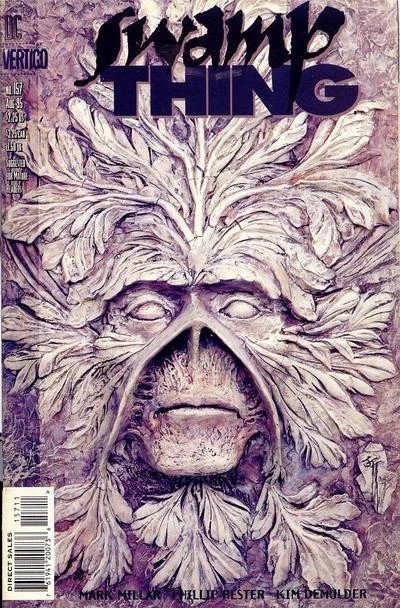
The cover of issue 157 of Swamp Thing (1995) depicting Swamp Thing in architectural “Green Man” motif. Oil painting by artist extraordinaire John Totleben. Copyright owned by DC Comics.
 Robert Martel | Illustrator
Leave a comment